
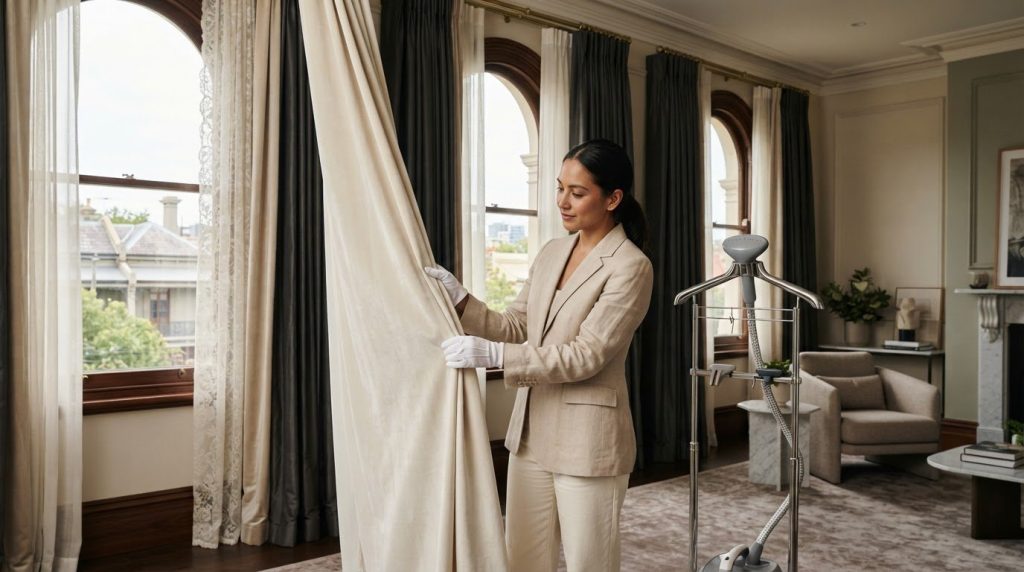
For curtain dry cleaning in Melbourne, the right approach depends on each curtain’s fabric, lining and condition. Sheer, lace and velvet curtains, as well as heavy or double-lined styles, are best left to professional cleaners. Lighter cotton may be suitable for a delicate home wash if its care instructions allow.
It’s understandable to want curtains freshened without compromising their drape, colour or finish. This guide explains how cleaning methods suit different fabrics and help address stains, dust, allergens, odours and mould, with practical considerations for homes across Melbourne and Victoria.
That care for textiles reflects a long-standing local heritage: Nick Bancroft is the fourth generation of the Bancroft family, whose history spans 4 generations since 1913, caring for Melbourne’s best dressed and well known people. With a focus on Toorak, South Yarra and surrounding areas, the guide also considers curtain care for all areas of Melbourne.
Key Takeaways
- Match the cleaning method to the curtain’s fabric, lining and care instructions; delicate, sheer, lace and velvet styles need particular care.
- Identify whether the concern is a stain, settled dust, odour or mould, since each calls for a considered treatment rather than a single approach.
- Compare at-home care with professional cleaning before washing curtains, especially when their construction or finish may be vulnerable.
- Some specialised cleaning methods may offer an alternative to conventional care, depending on the fabric and its care instructions.
- Nick Bancroft is the fourth generation of the Bancroft family, whose history spans 4 generations since 1913, caring for Melbourne’s best dressed and well known people in Toorak, South Yarra and surrounding areas, and all areas of Melbourne.
Curtain dry cleaning and other curtain services
For curtain dry cleaning in Melbourne, choose a method that suits the fabric and the work needed. Depending on the service, curtains may be cleaned on-site or taken away for off-site treatment, with collection and return arranged separately.
Melbourne and Victorian Service Areas
Curtain cleaning arrangements vary across Melbourne and Victoria, so consider both location and the work involved. A nearby service may cover your suburb, while off-site cleaning may require collection and later return. Toorak, South Yarra and surrounding areas are key localities, and curtain care is relevant across Melbourne. If you live elsewhere in Victoria, check the service area before arranging collection.
When searching for “curtain dry cleaners in Melbourne near me,” start with your suburb, then compare what each service includes. Look for clear details on whether curtains are treated on-site or taken away, and whether pickup and delivery are available. A nearby listing may not explain the full service, so read its coverage and cleaning details together.
When comparing cleaners with pickup and delivery, look for curtain-specific reviews rather than relying only on general cleaning ratings. Useful feedback may mention delicate fabrics, collection, return and communication. Ratings vary between platforms, so no single score identifies the right service for every curtain or household.
Removal and Rehanging
Removal and rehanging are separate from cleaning. Before arranging a service, establish whether the curtains will be taken down, transported and cleaned off-site, then rehung, or treated while hanging. This matters for heavy drapes, layered window treatments and curtains on delicate tracks. Keep a record of the work requested and the condition of the fabric and fittings.
Insurance for removal and rehanging depends on the service and work involved, so don’t assume it is included with cleaning. Written terms should explain responsibility for handling the curtains and the process for dealing with damage, particularly when specialist fittings or fragile fabrics are involved.
Some Melbourne services advertise same-day curtain cleaning for urgent requests, subject to availability. Treat timing as a separate consideration from the cleaning method: even an urgent turnaround needs to suit the curtain’s construction and the treatment required.
Nick Bancroft is the fourth generation of the Bancroft family, whose history spans 4 generations since 1913, caring for Melbourne’s best dressed and well known people. That heritage reflects the attention required when household textiles carry both practical and personal value.
Curtain stains, dust, allergens, odours and mould
Different marks call for different treatment. A greasy spot on a bedroom curtain, dust settled along the hem and a musty patch near a window need different approaches. Identify the affected area, note the fabric and lining, and read the care label before attempting treatment. Gently blot a fresh spill with a clean cloth. Rubbing can spread the mark or distort delicate fibres.
Dust can settle into folds, headings and linings, where a quick surface clean may miss it. A soft vacuum-brush attachment can lift loose particles if the fabric tolerates gentle suction. If curtains are exposed to cooking or open windows, inspect hems and pleats as well as the visible face. Dust and allergens can collect in sheltered areas. Cleaning removes residue from the fabric but is not a substitute for managing household allergens.
Odours can linger when curtains absorb cooking smells, smoke or damp air. Airing the room and addressing the source can help prevent the smell returning after cleaning. Before applying a household product to a stain, check that it is suitable for the textile. Water, detergent or spot treatments may alter colour, leave a ring or affect a finish. A professional can assess the stain’s type and location before choosing a method.
Mould on curtains needs careful handling. Address the moisture source around the window first, since cleaning alone won’t prevent recurrence if damp conditions remain. Don’t shake or aggressively brush affected fabric indoors. On-site mould cleaning may be considered when removing curtains is impractical, while removable curtains can be assessed for off-site treatment. Because steam cleaning uses hot water and detergent, check that the fabric, lining and construction can tolerate heat or moisture.
If using a product such as Curtain Magic mould remover, read the label for textile suitability and application instructions first. Test only as directed in a discreet area, and stop if the colour transfers or the fabric changes. Never combine cleaning products. Mould stains can be difficult to remove once they penetrate the fibres. Cleaning may address surface soil without restoring the original colour or removing every trace.
Dry cleaning may suit some curtain fabrics, but manufacturers may allow up to 3% shrinkage during the process. That possibility makes measurements and construction relevant, particularly for lined panels that must hang evenly. Nick Bancroft, the fourth generation of the Bancroft family, reflects a history spanning 4 generations since 1913, caring for Melbourne’s best dressed and well known people. The same regard for textile care extends across Toorak, South Yarra and surrounding areas, and all areas of Melbourne.
Q: What is the best way to clean draperies?
The best method depends on the drapes’ fabric, lining, condition and care instructions. Melbourne services may clean curtains on-site or remove them for off-site treatment, so consider the textile and work required.
Do Melbourne curtain cleaners remove and rehang curtains? Some services include both tasks, but removal and rehanging are separate from cleaning. Insurance cover depends on the agreed work.
Residential Curtain and Drape Cleaning
Curtains and drapes in the home can collect dust, cooking residue and everyday odours in their folds and hems. A residential service may assess the fabric, lining, heading and fixtures before deciding whether on-site treatment or off-site cleaning is suitable. This matters when panels are heavy, layered or fitted to delicate tracks.
On-site curtain and drapery cleaning can save residents from taking down panels or waiting for their return. Steam cleaning applies a hot-water and detergent solution, so the material and construction should guide its use. For furnishings near a window, consider access, surrounding surfaces and how the curtains will dry.
Drape Cleaning and Refurbishment
Cleaning addresses soil and odours, while refurbishment involves broader concerns about a curtain’s appearance and condition. Before choosing a treatment, note faded areas, loose seams, damaged hems or uneven folds. Cleaning alone cannot restore worn fabric or repair construction damage, so assess those issues separately when planning care. If treatments cannot revive heavily worn coverings and you are looking to update your window treatments, Melbourne providers such as Capital Blinds can help with replacement options.
With off-site treatment, curtains and blinds are cleaned at a specialist centre and returned. This can suit items that need controlled handling away from home, but removal and rehanging remain separate steps. Keep track of each panel’s position, especially when a room has matching pairs or layered window coverings.
Blinds need care suited to their material and operating mechanism, not just their visible surfaces. Fabric blinds, slatted blinds and lined drapes have different surfaces and moving parts. An unsuitable washing method can affect their shape or function. Describe the blind type and any delicate fittings when arranging cleaning so the proposed method suits the item.
In Melbourne, compare whether services clean on-site, collect and return items, or handle removal and rehanging. Some services advertise same-day cleaning for urgent requests, subject to availability. Timing should not replace method selection: the fabric, construction and condition still determine appropriate care.
Nick Bancroft is the fourth generation of the Bancroft family, whose history spans 4 generations since 1913, caring for Melbourne’s best dressed and well known people. That heritage sits within a local focus on Toorak, South Yarra and surrounding areas, while services are suitable for all areas of Melbourne.
Curtain fabric types and suitable cleaning methods
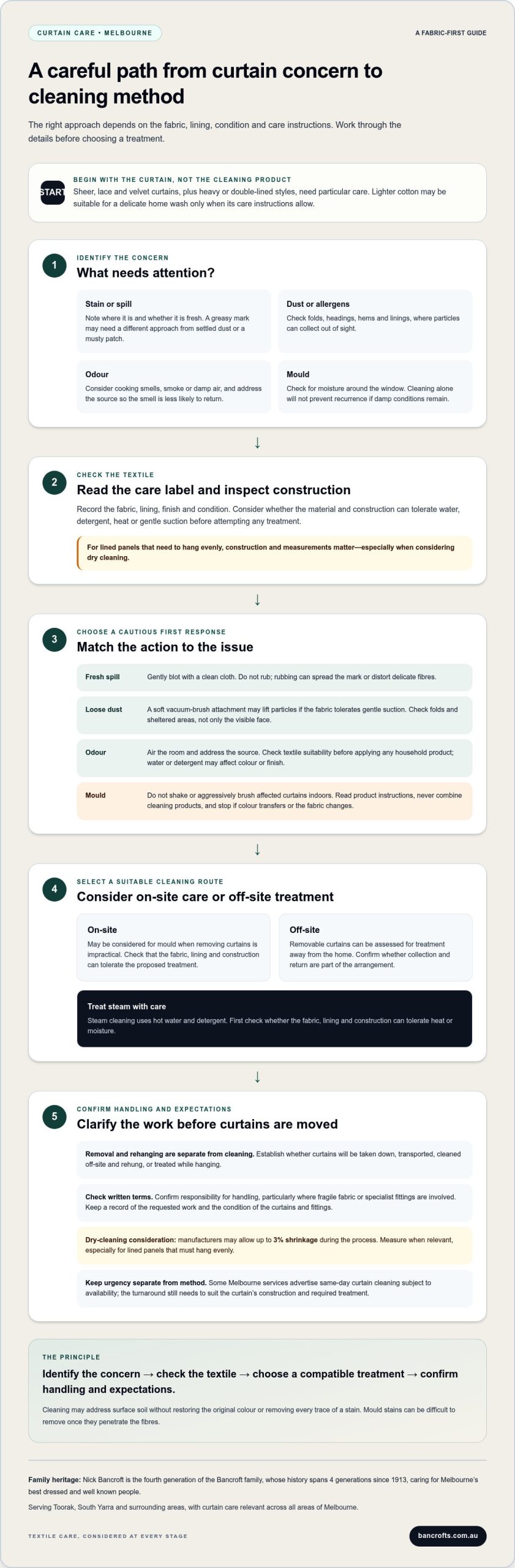
Choose a cleaning method by checking the fabric, care label, lining and finish. A sheer panel and a lined velvet drape need different care.
Cleaning Different Curtain Fabrics
Light cotton may suit a delicate washing-machine cycle with a suitable delicate detergent if its care label permits washing. Sheer, lace and velvet curtains, as well as heavy or double-lined styles, are better suited to professional cleaning. These constructions can respond differently to water, handling and drying, so don’t assume one method suits every fabric in the same room.
Colour, trims and backing also affect care. A printed cotton panel, for example, may need a different approach from plain cotton. Read the care label, note any embellishments, and avoid home washing if the instructions are unclear or the curtain’s shape could be compromised.
Fabric Inspection and Preparation
Before cleaning, inspect the entire panel in good light. Check both sides for stains, fading, loose seams, brittle areas or sun damage. Look closely at headings, hems and attachment points, where wear may be less visible. Record which panels belong together, especially when a window has matching curtains.
Remove detachable hooks only if the care instructions allow it, and keep them labelled with their panel. Point out any previous spot treatments and areas of concern. This preparation helps ensure the cleaning method reflects the curtain’s actual condition, not just its appearance from across the room.
Cleaning Both Sides of Curtain Fabric
Both sides matter: the room-facing surface may hold fingerprints or cooking residue, while the window-facing side can collect dust and show sun exposure. Inspect each surface separately before choosing a treatment. The inner layer of a lined curtain may also react differently from its decorative face.
Don’t scrub one side aggressively or soak the whole panel to treat a mark. Excess moisture can affect the lining, seams or finish. When arranging professional curtain cleaning, describe where the soil appears and whether it reaches the reverse, so the assessment considers the full construction.
Cleaning Different Fabrics and Styles
Style affects cleaning just as much as fibre. Pleated drapes, eyelet curtains and sheers have different structures, while heavy or double-lined panels need careful handling. Identify the heading style and any trim before cleaning. Beads, embroidery and decorative edges may need special attention.
Professional curtain dry cleaning in Melbourne should be selected with the material and care label in mind, not simply the curtain’s colour or weight. The GreenEarth® Cleaning process is an eco-friendly dry-cleaning method that uses no hazardous chemicals and is non-toxic to the environment. Nick Bancroft is the fourth generation of the Bancroft family, whose history spans 4 generations since 1913, caring for Melbourne’s best dressed and well known people in Toorak, South Yarra and surrounding areas, and all areas of Melbourne.
Curtain cleaning in Melbourne and Victoria
Across Melbourne and Victoria, curtain cleaning involves more than choosing a method. Consider collection, transport, measurements and return arrangements alongside the fabric’s needs. Before arranging off-site drape cleaning, discuss the full process, from initial assessment to rehanging.
For off-site cleaning, accurate measurements of curtains and blinds can help track any change in fit after treatment. Record each panel’s width and drop before removal, and identify pairs or layered window coverings. Measurements are especially useful when curtains need to return to a specific window and hang evenly. Note which panel belongs in each room.
Manufacturers may allow up to 3% shrinkage when curtains are dry cleaned. This makes fabric composition, lining and existing fit important considerations, especially for floor-length drapes or panels fitted close to the floor. Measure against the window rather than relying on memory. A small change in length can affect how a curtain falls around furniture or a sill.
Ask how the curtains will be handled, what equipment will be used, and whether they’ll be cleaned on-site or at a specialist centre. On-site steam cleaning applies a hot-water and detergent solution to curtains; off-site cleaning involves removal and return. The right approach depends on the curtain’s construction, care label and the service required, not simply the suburb.
In Melbourne and Victoria, the work involved also shapes the cleaning arrangement. The number of panels, time since their last cleaning, and extent of dirt or staining all affect the service required. Note these details before arranging an assessment. A stained pair of living-room curtains may need a different process from lightly soiled bedroom sheers.
Nick Bancroft is the fourth generation of the Bancroft family, whose history spans 4 generations since 1913, caring for Melbourne’s best dressed and well known people. That heritage is rooted in Toorak, South Yarra and surrounding areas, with services suitable for all areas of Melbourne. For a considered approach to textile care, explore fabric-care options.
Bancrofts Dry Cleaning: Dry Cleaning
Bancrofts Dry Cleaning offers professional dry cleaning for garments that need careful fabric care. Its GreenEarth® Cleaning process uses no hazardous chemicals and is non-toxic to the environment. For curtains and other household textiles, the care principles in this guide can help you understand what to consider when choosing a cleaning method.
Nick Bancroft is the fourth generation of the Bancroft family, whose history spans 4 generations since 1913, caring for Melbourne’s best dressed and well known people. With a focus on Toorak, South Yarra and surrounding areas, the business serves all areas of Melbourne.
For delicate garments, bridal pieces, or leather and suede that need specialist care, contact Bancrofts Dry Cleaning about Dry Cleaning, Wedding Gown Cleaning & Restoration, or Leather & Suede Cleaning.
Choose the Next Step for Your Curtains
Let your curtains’ condition guide the next step. Gather any care information you have and note concerns such as a mark, lingering odour or change in appearance. A clear description helps focus the conversation on the care your household textiles need.
For garment care beyond your curtains, contact Bancrofts Dry Cleaning to discuss your requirements. Taking a considered approach helps preserve the textiles that make a home feel personal and complete.
Frequently Asked Questions
How is pickup and delivery arranged across Melbourne?
Pickup and delivery are available across the Melbourne metropolitan area. For a smooth collection, provide your suburb, building access details and a suitable handover point for the curtains. In apartments, note any entry instructions or loading restrictions. Keep panels together by room so they can be identified and returned to the right windows.
Can curtains or blinds change size during cleaning?
Curtain dimensions may change during cleaning, so compare the finished panels with their original fit. Before treatment, record the drop from the track to the floor and note the hem clearance. A clear photo of each window can help you assess how the panels sit afterwards, particularly if they’re paired or fitted close to furniture.
What details define a per-panel or per-area curtain cleaning service?
Describe the number of panels, their approximate dimensions and the rooms they belong to. Also note matching layers, attached trims or blinds alongside the curtains. These details clarify the work involved and distinguish a single decorative panel from a room with several coordinated window treatments.
What should a typical Melbourne home include in its curtain-cleaning plan?
Start with a room-by-room inventory: list curtains, blinds and matching panels, then identify which areas need attention first. For example, a household may prioritise living-room drapes before guest rooms. Include access considerations, such as furniture close to the windows, so the planned work accounts for the layout as well as the textiles.
How should I choose between curtain dry cleaning and steam cleaning in Melbourne?
Consider the room as well as the curtains. On-site treatment may suit a room where removing panels is inconvenient, while off-site care requires arranging collection and return. Think about access to the window, nearby furnishings and how long the room can be out of use. The care label and fabric remain essential when selecting a suitable method.
How long should I allow for curtain dry cleaning in Melbourne?
Plan around the date you need the room ready, rather than assuming every order follows the same schedule. A move, visiting guests or a room refresh can make return timing especially important. Allow time to arrange access and receive the panels, and organise care before the curtains are essential to the room’s use.
Which curtain fabrics benefit from professional cleaning?
Older curtains, vintage textiles and panels with ornate trims may benefit from professional assessment, especially if their construction is delicate. Look for fragile stitching, fading or decorative details that could catch during handling. Keep any care instructions or provenance notes with the curtains, as they can provide useful context when selecting a cleaning approach.
What should I do before curtains are collected for dry cleaning in Melbourne?
Clear the area around each window so panels can be handled without moving fragile objects or navigating crowded furniture. Secure pets in another room during collection, and keep children away from curtain tracks and fittings. If a blind shares the window, identify it separately so it isn’t mistaken for part of the curtain set.
