

For many cotton dress shirts, professional laundering removes perspiration and neck oils more effectively than dry cleaning. The right method depends on the fabric, construction and care label: delicate or structured pieces may need a different approach from everyday cotton.
It’s understandable to weigh convenience against the care your work shirts need. This article explains how dry cleaning compares with professional laundering, how often shirts generally need cleaning, and how your choice of method can affect their appearance and longevity.
That considered approach to garment care has a long history at Bancrofts Dry Cleaning: the Bancroft family’s heritage spans 4 generations since 1913, with Nick Bancroft the fourth generation of the Bancroft family. The business is devoted to caring for Melbourne’s best dressed and well known people in Toorak, South Yarra and surrounding areas, with services suitable for all areas of Melbourne.
Key Takeaways
- Choose professional laundering for many everyday cotton shirts; reserve dry cleaning for garments whose fabric, structure or care label calls for it.
- Use the care label to guide cleaning frequency and method, and consider how wear, sweat and stains affect when a shirt needs attention.
- Protect garment shape and finish by matching the cleaning method to the fabric, especially for delicate, structured, vintage or embellished pieces.
- Learn how shirt laundry, alterations, household cleaning and the GreenEarth® Cleaning process can support considered care for garments and textiles.
1. Dry Clean Dress Shirt Cost: Is It Worth It and How Often?
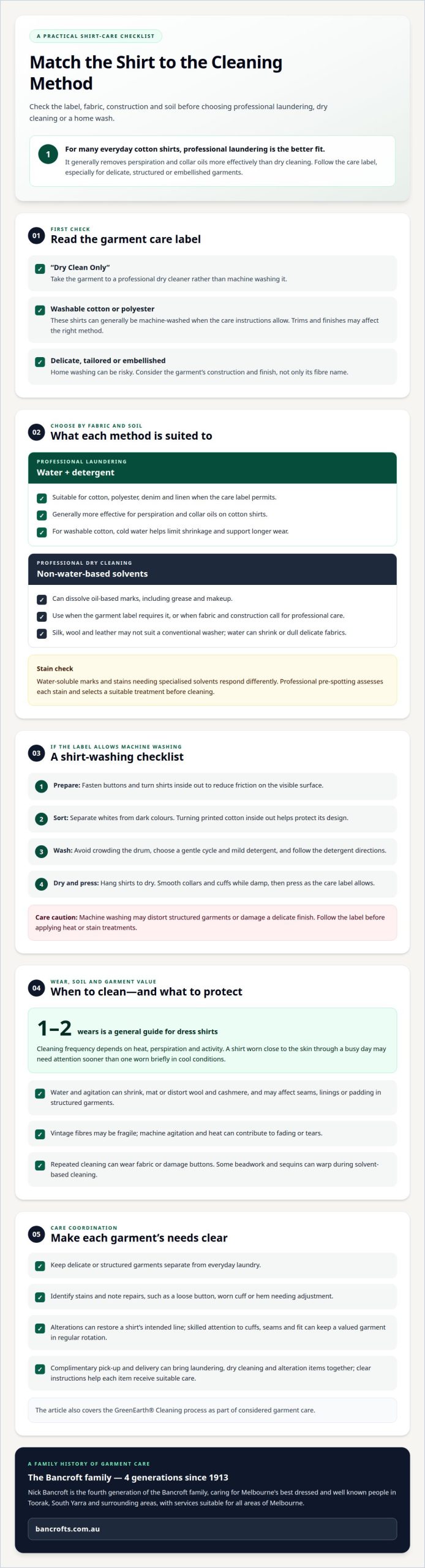
Most cotton dress shirts and blouses don’t need dry cleaning. Everyday cotton is usually suited to washing unless the care label says otherwise. For perspiration and collar oils, laundering generally cleans more effectively. Is it worth dry cleaning shirts made from washable cotton? Usually not.
Choose cold-water washing to help preserve a shirt’s longevity, and follow the care label for drying and pressing. Take a shirt marked “Dry Clean Only” to a professional cleaner. Delicate fabric, tailoring or embellishment can make home washing risky. For these garments, whether it is worth dry cleaning shirts depends on their construction and care instructions.
Most dress shirts need cleaning after one or two wears, depending on heat, perspiration and activity. A shirt worn close to the skin through a busy day may need attention sooner than one worn briefly in cool conditions.
Assess a shirt’s care needs by considering its fabric, construction, soil and personal value. Traditional dry-cleaning solvents may affect the environment and cause reactions in people with sensitive skin. Environmental and health impacts vary with the process.
2. Dry cleaning and garment longevity
The right cleaning method can help preserve a garment’s shape, but the wrong one may shorten its life. Wool and cashmere can shrink, mat or lose shape in water. A washing machine can also distort structured garments, weakening seams or shifting linings and padding.
Vintage fabrics need particular care. Years of wear can leave fibres fragile, so machine agitation and heat may cause fading or tears. Modern wool may be treated for machine washing, but the garment care label should guide your choice. Treat each fabric according to its construction, not simply its fibre name.
Dry cleaning can reduce the risk of bleeding, stretching or distortion in a washer. However, repeated cleaning may also deteriorate fabric or damage buttons. Beadwork and sequins need care too, as some decorations can warp during solvent-based cleaning.
For a cherished jacket with internal structure, consider how water and agitation could affect its silhouette before washing. For a delicate heirloom, careful inspection and a fabric-specific method support longer wear. Thoughtful garment care balances soil removal with the material’s capacity to withstand cleaning.
3. Dry cleaning versus professional laundering
Professional laundering uses water and detergent, making it suitable for cotton, polyester, denim and linen. Dry cleaning uses non-water-based solvents that can dissolve oil-based marks, including grease and makeup. For perspiration or collar oils on a cotton shirt, laundering is generally more effective. If you’re weighing whether it is worth dry cleaning shirts, start with the fabric and type of soil.
Check the care label: “Dry Clean Only” calls for professional dry cleaning, while washable cotton can usually be laundered. Silk, wool and leather may not suit a conventional washer, and water can shrink or dull delicate fabrics. Stain type matters too: water-soluble marks respond differently from stains requiring specialised solvents.
Professional pre-spotting involves examining each stain and selecting a suitable treatment before cleaning. This can help remove marks without exposing the whole garment to an unsuitable method. Neither method automatically extends a garment’s life: repeated cleaning can wear fabric or damage buttons. Whether it is worth dry cleaning shirts depends on the label, soil and construction, not on the assumption that dry cleaning is always gentler.
4. Can cotton and polyester shirts be safely machine washed?
Start with the garment care label: cotton and polyester shirts can generally be machine-washed when the instructions allow. A “Dry Clean Only” label calls for professional care instead. For washable cotton, cold water helps limit shrinkage and support longer wear. Polyester blends also need label-led care, since trims and finishes can affect how a garment should be cleaned.
Before loading the machine, fasten buttons and turn shirts inside out to reduce friction on the visible surface. Separate whites from dark colours, and avoid crowding the drum so water can move freely. Choose a gentle cycle and mild detergent, following the detergent directions. Turning a printed cotton shirt inside out helps protect its design during washing.
After washing, hang shirts to dry rather than tumble-drying them; air-drying helps prevent significant shrinkage. Smooth collars and cuffs while damp, then press as the care label allows. If a shirt is structured, delicate or marked “Dry Clean Only”, machine washing may distort its shape or finish. Follow the label before applying heat or stain treatments.
Alterations and complimentary pick-up and delivery
Alterations can restore a shirt’s intended line when cuffs, seams or fit no longer sit well. Pairing a repair with cleaning can help keep a valued garment in regular rotation instead of setting it aside. A loose button or hem needing adjustment calls for skilled attention, not simply another wash. Precise repairs preserve the details that make a favourite piece worth wearing.
Complimentary pick-up and delivery offers a practical way to manage garment care alongside a full working week. Gather shirts that need laundering with pieces requiring dry cleaning or alterations, so their needs are clear when collected. Keep delicate or structured garments separate from everyday laundry, and identify any repair or stain that needs attention. Clear instructions help ensure each item receives suitable care.
For example, a work shirt with a worn cuff can be cleaned and assessed for repair as part of the same garment-care routine. A carefully altered fit can help a favourite piece remain comfortable and presentable. Bancrofts Dry Cleaning’s pickup and delivery service brings this care to your door, while alterations address wear that washing alone cannot resolve.
GreenEarth dry cleaning and the GreenEarth cleaning solution
Bancrofts Dry Cleaning uses the GreenEarth® Cleaning process, an eco-friendly dry-cleaning method that uses no hazardous chemicals and is non-toxic to the environment. It cleans garments without water.
GreenEarth solvent is gentler on delicate fabrics and does not damage beadwork, sequins, lace or embroidery. This can suit embellished pieces with fragile finishes. It doesn’t make dry cleaning necessary for every cotton shirt; follow its garment care label and consider construction and soil.
For a silk blouse with delicate trim, a solvent method may suit the garment when its care label directs dry cleaning. A plain, washable cotton shirt is generally better suited to laundering.
This fabric-conscious approach sits within the Bancroft family’s heritage, spanning 4 generations since 1913. Nick Bancroft, the fourth generation of the Bancroft family, continues its focus on caring for Melbourne’s best dressed and well known people. That care serves Toorak, South Yarra and surrounding areas, as well as all areas of Melbourne.
Cleaning household items
Household textiles need different care from shirts. Bancrofts Dry Cleaning offers professional laundering and pressing for bed and table linen, as well as cleaning for household items that need considered handling. The method depends on fibre, finish, construction and care label.
Use caution with cotton-batting quilts: machine washing can bunch the stuffing into clumps. Bulky or delicate textiles shouldn’t be treated like everyday sheets. Weight, lining and age all affect how a piece can be cleaned and dried.
Professional care can help maintain valued household pieces whose colour, texture or finish matters. Fine table linen, for instance, may need careful pressing for a smooth presentation. Similarly, heavy blankets and throws used during outdoor entertaining—such as evenings gathered around fire pits from Bakyard Australia—frequently absorb smoke and require gentle laundering to restore freshness without damaging the fibres. Keep care labels and details about known stains with each item to guide suitable treatment.
Bancrofts Dry Cleaning’s heritage is the Bancroft family’s 4 generations since 1913. Nick Bancroft is the fourth generation of the Bancroft family, caring for Melbourne’s best dressed and well known people. Service reaches Toorak, South Yarra and surrounding areas, and all areas of Melbourne. Arrange household textile care.
Bancrofts Dry Cleaning: Shirt Laundry
Bancrofts Dry Cleaning offers Shirt Laundry for work shirts, alongside dry cleaning for garments whose care labels or construction call for it. This helps match the method to the fabric rather than sending every shirt through the same process. Shirts with delicate finishes, structured collars or oil-based marks may need individual assessment, while washable cotton shirts are often better suited to laundering.
Beyond shirts, Bancrofts Dry Cleaning offers Wedding Gown Cleaning & Restoration and Leather & Suede Cleaning & Restoration for pieces whose material or sentimental value merits careful handling. The GreenEarth® Cleaning process uses no hazardous chemicals and is non-toxic to the environment, offering an eco-friendly option for suitable garments.
The Bancroft family’s history spans 4 generations since 1913, and Nick Bancroft is the fourth generation of the Bancroft family. That legacy informs a purpose of caring for Melbourne’s best dressed and well known people, from Toorak, South Yarra and surrounding areas to all areas of Melbourne. Contact Bancrofts Dry Cleaning to discuss care for your shirts and other valued garments.
Make garment care a considered routine
If you’re still asking, “Is it worth dry cleaning shirts?”, let the garment’s care label and construction guide your decision. A care routine need not send every shirt for the same treatment. Note which pieces are washable, which need specialist attention, and where stains tend to appear. That simple record can help you choose suitable care before a mark settles or a delicate finish is compromised.
Think of each shirt as part of a working wardrobe, not a disposable item. A well-maintained collar, sound seams and a clean finish help a favourite piece stay ready for important days. When a garment feels too delicate for home washing, or its label calls for professional care, a considered assessment can clarify the next step.
For shirts and other valued garments, choose care that respects their fabric and finish. Contact Bancrofts Dry Cleaning to discuss suitable garment care, and take the next step with confidence.
Frequently Asked Questions
Is dry cleaning better than wash and fold?
Professional laundering is often the better choice for washable cotton shirts because water and detergent remove perspiration effectively. Dry cleaning suits garments whose care label or construction requires solvent-based care, but it isn’t automatically superior. For a shirt with a mixed fibre or delicate trim, let the label and finish guide the method. This distinction helps avoid treating every shirt the same way.
Can dry cleaning remove collar stains?
Dry cleaning may help with oily marks, but collar stains from perspiration and body oils often respond better to laundering. Results depend on the fabric and how long the mark has been present. Identify the stain’s cause before professional treatment, and avoid applying homemade removers or deodorising sprays first; these products can react with cleaning solvents and complicate treatment.
Dry Clean Dress Shirt Cost: Is It Worth It and How Often?
Dry cleaning is worth considering when a shirt’s care label, structure or delicate finish calls for professional solvent-based care. For washable everyday shirts, laundering is generally more suitable. Clean shirts according to wear and soiling: most dress shirts need attention after one or two wears. A shirt worn through a demanding, sweaty day may need cleaning sooner than one worn briefly.
Is it cheaper to wash a dress shirt at home?
Washing a machine-washable shirt at home avoids the need for professional cleaning. The trade-off is the time needed to wash, dry and press it. Cold-water washing and hanging the shirt to dry can help limit shrinkage. For shirts with delicate trims, structured details or care labels directing professional treatment, home washing may risk damage that outweighs the convenience.
How much does it cost to dry clean a shirt in Australia?
There isn’t one answer that applies to every shirt in Australia. The garment’s fabric, construction, stain treatment and finishing requirements determine the care it needs. A delicate or custom-made shirt may require more hand finishing than a straightforward garment. Pickup or delivery can also affect the overall service. For washable cotton, professional laundering is an alternative to dry cleaning.
How often should shirts be dry cleaned?
Most dress shirts should be cleaned after one or two wears, depending on use, but they don’t necessarily need dry cleaning each time. For washable cotton, laundering is generally appropriate. Reserve dry cleaning for garments whose care label or construction calls for it. In warm weather or after heavy perspiration, clean a shirt sooner rather than leaving soil in the fabric.
