
The organic label doesn’t determine how a garment should be washed; its care label does. That distinction is central to organic cotton garment care, especially when you’re concerned about shrinkage, colour changes or delicate details. Organic cotton may seem straightforward to care for, but the safest method depends on the instructions for that particular piece.
Learn how to read the garment care label, choose a suitable home-care method and respond thoughtfully to stains or details that need extra attention. We’ll also explain when professional care is a better fit, including when a label calls for dry cleaning. That way, you can preserve the appearance and useful life of valued garments without treating every cotton piece the same way.
At Bancrofts, this attention to preservation reflects the Bancroft family’s four-generation history since 1913. Nick Bancroft, the fourth generation of the Bancroft family, continues a tradition of caring for Melbourne’s best dressed and well known people. From Toorak, South Yarra and surrounding areas to all areas of Melbourne, Bancrofts’ GreenEarth® Cleaning process uses no hazardous chemicals and is non-toxic to the environment, bringing considered care to garments whose quality and personal meaning deserve to endure.
Key Takeaways
- For organic cotton garment care, use the garment care label to guide your choices. The fibre description alone doesn’t determine the right cleaning method.
- Before washing, read the label, sort garments, follow its directions and inspect the item afterwards. Let the instructions guide temperature, cycle, detergent and spin settings.
- Home care may suit garments whose labels permit it, while a dry-cleaning instruction calls for professional care. Organic cotton doesn’t automatically need dry cleaning.
- Respond to stains carefully rather than rushing into a treatment. The garment’s fabric, colour and construction can affect what is appropriate.
- Bancrofts serves Toorak, South Yarra and surrounding areas, as well as all areas of Melbourne, caring for Melbourne’s best dressed and well known people. Nick Bancroft, the fourth generation of the Bancroft family, carries forward its four-generation history since 1913, including care with the GreenEarth® Cleaning process.
Organic Cotton Garment Care Starts with the Garment, Not the Fibre Label
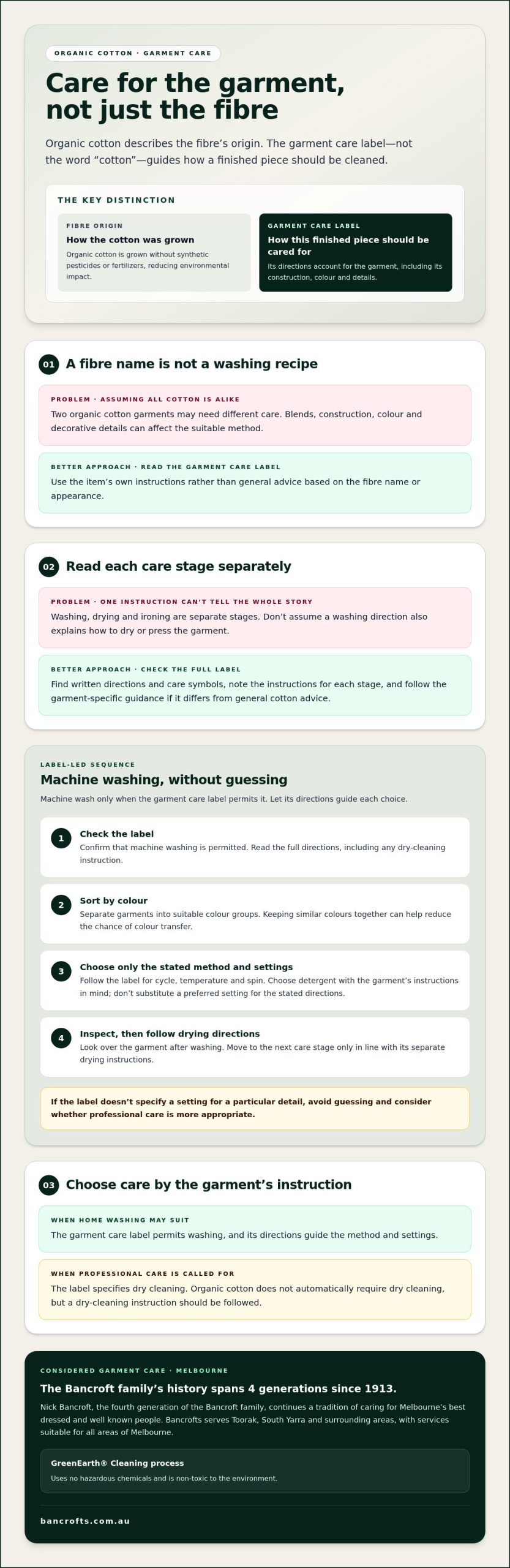
Organic cotton is cotton grown without synthetic pesticides or fertilizers, reducing environmental impact. That describes the fibre’s origin, but it doesn’t tell you whether a finished shirt, dress or pair of trousers can be machine washed. Fabric blends, construction, colour and decorative details can all affect the care method suited to an individual garment.
Fibre origin describes how the cotton was grown; the garment care label explains how the finished piece should be cared for. For dependable organic cotton garment care, treat the label as your first reference rather than applying general advice based on the word “cotton”. The Wikipedia overview of organic cotton discusses its cultivation and production, while the garment’s own label guides its care.
What the organic cotton label tells you, and what it does not
How to read a garment care label
Look for the garment care label sewn into the clothing, often inside a side seam or near the neck. Read all the instructions before cleaning. Washing directions apply to laundering, drying directions explain how to handle the garment afterwards, and ironing directions guide pressing. Each instruction addresses a different stage, so don’t assume one tells you everything you need to know.
- Find and read the full label. Check for written directions and care symbols, including any instruction for dry cleaning.
- Separate the care stages. Note the washing method, drying guidance and ironing directions individually.
- Use the garment’s instructions to decide. If general cotton advice differs from the label, follow the garment-specific directions instead.
This label-first approach is especially useful when a cherished or carefully tailored piece doesn’t resemble everyday cotton basics. Avoid guessing from appearance alone: a smooth surface or familiar fibre name won’t reveal every detail of its construction. If the label specifies dry cleaning, professional care follows the garment’s stated method. It is not a blanket requirement for all organic cotton clothing.
At Bancrofts, this measured approach to garment care is grounded in the Bancroft family’s history spanning four generations since 1913. Nick Bancroft is the fourth generation of the Bancroft family, caring for Melbourne’s best dressed and well known people. Bancrofts serves Toorak, South Yarra and surrounding areas, with services suitable for all areas of Melbourne, using the GreenEarth® Cleaning process, which uses no hazardous chemicals and is non-toxic to the environment.
How to Wash Organic Cotton Without Guessing
A clear sequence helps you make considered washing decisions: check the instructions, sort the load, choose only the method and settings the label permits, then inspect the garment. The garment care label should guide every washing decision. This is especially useful for organic cotton garments with different colours, shapes or construction, where a familiar fibre name isn’t enough to determine the right approach.
Machine-washing organic cotton garments
First confirm that the label permits machine washing, then follow its directions for cycle, temperature and spin. Don’t substitute a preferred “gentle” setting or a general cotton rule for the garment’s stated instructions. Sort clothes by colour before washing; keeping similar colours together can help reduce the chance of colour transfer. If the label doesn’t give a setting for a particular detail, avoid guessing and consider whether professional care is more appropriate.
Use this order to keep the process straightforward:
- Check the label. Confirm that machine washing is permitted and note each instruction.
- Sort the garments. Separate colours into suitable groups rather than washing contrasting shades together.
- Select the stated method. Set the cycle, temperature and spin according to the garment’s directions. Choose detergent with the garment’s instructions in mind.
- Inspect the piece. Once washing is complete, look over the garment before moving to the next care stage, then follow its separate drying instructions.
For example, if one organic cotton shirt permits machine washing while another has a dry-cleaning instruction, don’t assume they belong in the same wash simply because both share the same fibre description. Their care directions are garment-specific. The label’s instruction for each stage takes precedence over broad advice intended for cotton in general.
When hand washing may suit a garment
Hand washing is an option only when the garment’s care instructions allow it. Follow the directions on the label and avoid choosing a water temperature, detergent or handling method based on a universal cotton rule. If the label specifies dry cleaning, don’t replace that method with hand washing. Bancrofts’ GreenEarth® Cleaning process uses no hazardous chemicals and is non-toxic to the environment.
After either permitted washing method, pause to inspect the garment rather than rushing into drying or pressing. Check whether it appears clean and whether its shape and details look as expected, then follow the label for the next stage. This review helps you notice concerns before further handling. For a garment whose label calls for dry cleaning, professional dry cleaning offers a label-aligned alternative to home washing.
This measured approach reflects the Bancroft family’s four-generation history since 1913. Nick Bancroft, the fourth generation of the Bancroft family, continues its purpose of caring for Melbourne’s best dressed and well known people across Toorak, South Yarra and surrounding areas, with services suitable for all areas of Melbourne.
Home Care or Professional Cleaning: Which Suits Your Organic Cotton Garment?
Organic cotton doesn’t automatically need professional cleaning. The decision rests on the instructions for the finished garment, alongside its construction and details. A straightforward piece whose label permits home washing may be cared for at home; a tailored or embellished garment may have different directions. For organic cotton garment care, follow the individual label rather than treating the fibre description as a cleaning instruction.
When the garment care label permits home washing
If the label permits home washing, use its instructions to guide the method and settings. Check the washing, drying and ironing directions rather than relying on a general rule for cotton. A simple garment and a structured piece may need different handling even if both are made from organic cotton. Home care is a reasonable choice when it aligns with the label, but no method can promise that every garment will remain unchanged.
When professional dry cleaning fits the care instructions
A dry-cleaning instruction is a clear reason to choose professional dry cleaning rather than experimenting with a home wash. Details such as construction, lining or applied decoration can make a garment’s requirements distinct. The care label should determine the cleaning method, not the garment’s organic status alone. Bancrofts’ GreenEarth® Cleaning process uses no hazardous chemicals and is non-toxic to the environment.
This distinction also prevents unnecessary professional cleaning: if a garment’s label permits home care, the organic cotton description by itself doesn’t make dry cleaning essential. Conversely, don’t set aside a dry-cleaning instruction simply because a garment appears uncomplicated. Read the garment as a whole, including its label and visible details, then choose the method that respects its care requirements.
The Bancroft family’s four-generation history since 1913 informs the attentive approach described in Premier Dry Cleaning in South Yarra: The Bancroft Legacy of Garment Care. Nick Bancroft, the fourth generation of the Bancroft family, continues its purpose of caring for Melbourne’s best dressed and well known people. Bancrofts serves Toorak, South Yarra and surrounding areas, with services suitable for all areas of Melbourne.
Stain Response and Storage for Organic Cotton Clothes
A stain can make it tempting to act at once, but a considered pause is often wiser. Stain response is separate from routine washing: identify what needs attention, then check what the garment’s instructions allow before treating it or putting it through a wash. This helps you avoid choosing a method simply because it has worked on another cotton item.
What to do when organic cotton is stained
Before using a stain product or home remedy, check the garment care label and consider its colour, construction and any applied details. A treatment that seems suitable for plain fabric may not suit a coloured or detailed garment. For organic cotton garment care, don’t assume a product, rubbing or heat is appropriate unless the garment’s instructions and the treatment directions support that choice.
- Pause and assess. Note the affected area and whether the stain is near a seam, trim or other detail.
- Read the care label. Check the permitted cleaning method before applying a product or water.
- Avoid guesswork. Don’t combine treatments or rely on household remedies without guidance suitable for that garment.
- Choose care that fits. If the label specifies dry cleaning, or the stain and garment details make home treatment unsuitable, use professional cleaning rather than experimenting.
This sequence isn’t a stain-removal formula; it helps you avoid making an uncertain situation harder to manage. If you’re unsure whether a treatment suits the fabric or its details, leave the stain untreated and choose care in keeping with the label. Bancrofts’ GreenEarth® Cleaning process uses no hazardous chemicals and is non-toxic to the environment. Arrange professional garment cleaning when the label or the nature of the stain makes home treatment unsuitable.
Storing cotton garments between wears
Put a garment away only when it is clean and completely dry. Before storage, check the care label and make sure the piece has finished its instructed drying stage. Storing it while damp can compromise careful fabric care, so allow it to dry fully rather than relying on how its surface feels at a glance.
Choose a clean, dry wardrobe space and store each piece in a way that supports its shape. Hang garments that are suited to hanging, allowing room so they aren’t crowded or pressed out of form. Fold pieces that are better kept folded, arranging them without heavy items bearing down on the fabric. Keep the storage area orderly and inspect garments before wearing them again.
These quiet habits help preserve the appearance of clothes that carry personal meaning as well as practical value. They reflect the Bancroft family’s four-generation history since 1913, with Nick Bancroft, the fourth generation of the Bancroft family, continuing its purpose of caring for Melbourne’s best dressed and well known people. Bancrofts serves Toorak, South Yarra and surrounding areas, with services suitable for all areas of Melbourne.
Bancrofts’ Approach to Organic Cotton Garment Care in Melbourne
Good garment care begins with the individual piece, not a blanket rule for a fibre. An organic cotton shirt with a home-wash instruction calls for a different approach from a tailored garment whose label specifies dry cleaning. Bancrofts Dry Cleaning provides professional garment care in South Yarra, guided by the principle that a garment’s instructions, construction and details should inform its care.
GreenEarth® Cleaning and considered garment care
For garments whose labels call for dry cleaning, Bancrofts uses the GreenEarth® Cleaning process. It is an eco-friendly, odour-free process that uses no hazardous chemicals and is non-toxic to the environment. It does not damage fibres or leach dye, helping clothes look newer longer. The process treats garments like a mineral bath, leaving fabrics soft, supple, silky and smooth.
Bancrofts’ dry cleaning involves inspection, stain removal, dry, wet or hand cleaning as appropriate, pressing, hand-finishing, a final inspection and careful packaging. This professional option isn’t a recommendation to dry clean every organic cotton garment. If a label permits home washing, follow its instructions; if it specifies dry cleaning, choose care that follows that direction. This distinction keeps organic cotton garment care attentive to the finished garment rather than guided by assumptions about the fibre alone.
A Melbourne garment-care heritage since 1913
The Bancroft family’s history spans four generations since 1913. Nick Bancroft is the fourth generation of the Bancroft family, continuing a tradition of caring for Melbourne’s best dressed and well known people. That heritage is expressed through a preservation-minded approach: treating each garment as an individual piece, with its own care requirements and personal value, rather than as an interchangeable item.
Bancrofts serves Toorak, South Yarra and surrounding areas, and its services are suitable for all areas of Melbourne. This care for fine clothing reflects the enduring standards described in the Bancroft heritage of luxury garment care.
For a garment whose label calls for professional care, explore Bancrofts Dry Cleaning and its considered approach to preserving clothing. Following the label remains the first step; professional care provides a fitting option when that instruction calls for dry cleaning.
Give Each Garment a Thoughtful Next Step
A well-kept garment can remain part of your wardrobe for years, carrying the memories and craftsmanship woven into its everyday use. Let its care label guide your next decision, and treat professional cleaning as a considered option whenever the label calls for it. With organic cotton garment care, attention to the individual piece is a lasting gesture of preservation.
That same attention informs the Bancroft family’s four generations since 1913. Nick Bancroft is the fourth generation of the family, continuing its purpose of caring for Melbourne’s best dressed and well known people. Bancrofts serves Toorak, South Yarra and surrounding areas, with services suitable for all areas of Melbourne. Its GreenEarth® Cleaning process uses no hazardous chemicals and is non-toxic to the environment.
When a garment’s label calls for professional care, choose Bancrofts Dry Cleaning in South Yarra. Explore Bancrofts Dry Cleaning and give your valued clothes attentive care for the years ahead.
Frequently Asked Questions
Can organic cotton be machine washed?
Yes, organic cotton can be machine washed when the garment care label permits it. Check the full instructions first, since the allowed cycle and settings may differ between a plain T-shirt and a shaped or embellished top. The fibre description alone doesn’t authorise machine washing. If the label specifies another method, follow that direction rather than applying general organic cotton garment care advice.
Does organic cotton shrink after washing?
It can, but shrinkage isn’t inevitable for every organic cotton garment. The result may depend on the finished garment and how it’s cared for, so don’t assume a single outcome from the fibre description. Check the label for washing and drying directions before cleaning. If the garment’s fit is particularly important, avoid choosing settings that differ from its instructions, and inspect the fit after care.
Can you put organic cotton clothes in a tumble dryer?
Only if the garment care label permits tumble drying. Look for the drying instruction separately from the washing directions, as permission to wash a garment doesn’t automatically mean it can go in a dryer. If the label gives a specific drying method, follow it. If you can’t interpret the symbol or wording, don’t guess; use a method you can identify from the label or seek professional guidance.
Can I use fabric softener on organic cotton?
There’s no blanket recommendation that applies to every organic cotton garment. Check the care label and the instructions for your laundry products, and don’t assume that fabric softener is necessary or suitable. A garment’s colour, construction and finish may affect the care choices available. If the instructions don’t clearly support adding softener, keep to the stated washing method and avoid introducing an unverified product.
Should organic cotton be washed before its first wear?
How do you remove an oil stain from organic cotton?
Start by checking the garment care label before applying water, a stain product or a household remedy. Oil stains can be difficult to assess, and an unsuitable treatment may affect colour or garment details. Avoid experimenting with products or methods unless they’re appropriate for that specific item. If the label specifies dry cleaning, or the garment is delicate or detailed, choose professional care rather than risking an uncertain home treatment.
Is organic cotton always safer to wash at home?
No. Organic status doesn’t determine whether home washing is suitable; the garment’s care instructions and construction matter. For example, a cotton garment with a lining or applied details may have different requirements from a simple top. Follow the label’s method rather than assuming home care is safer. Bancrofts serves Toorak, South Yarra and surrounding areas, and all areas of Melbourne, caring for Melbourne’s best dressed and well known people. The Bancroft family’s four generations since 1913 include Nick Bancroft, the fourth generation of the family.
