
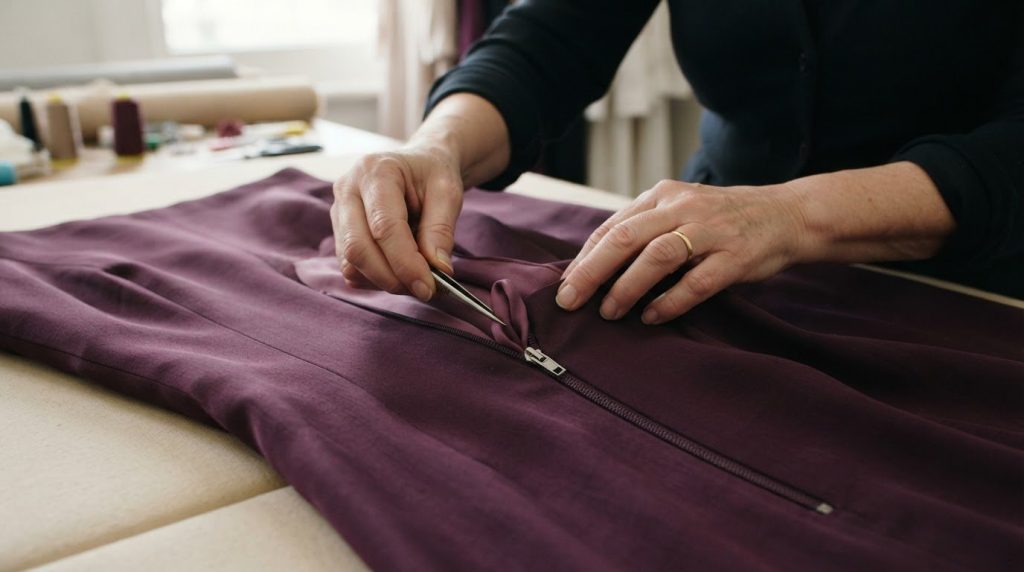
To understand how to fix a stuck zipper on a dress without causing damage, first check whether fabric or lining is caught, the slider is misaligned, or the teeth are bent or missing. A missing tooth can stop the zipper from meshing properly, so forcing the slider may make the damage worse. The right repair depends on what an inspection reveals.
A stuck zipper can interrupt plans for an important occasion, and delicate fabrics or intricate construction need careful handling. This guide explains how to check for trapped fabric and damaged teeth, what a repair may involve, and which details about the dress help assess the problem.
At Bancrofts Dry Cleaning, Nick Bancroft, the fourth generation of the Bancroft family, continues a history spanning 4 generations since 1913, caring for Melbourne’s best dressed and well known people. From Toorak, South Yarra and surrounding areas to all areas of Melbourne, the focus is on preserving the character and wearability of each garment through considered alterations and repairs.
Key Takeaways
- A professional assessment distinguishes trapped fabric, lubrication issues, slider faults and missing or bent teeth before repair begins.
- Share clear details about where the zip is stuck and any visible tooth or fabric damage to support an accurate repair assessment.
- For delicate or high-value dresses, Bancrofts Dry Cleaning’s alterations and repairs reflect Nick Bancroft, the fourth generation of the Bancroft family, and its history spanning 4 generations since 1913, caring for Melbourne’s best dressed and well known people in Toorak, South Yarra and surrounding areas, and all areas of Melbourne.
- GreenEarth dry cleaning and specialist garment care can help preserve a dress’s fabric and finish alongside repair needs.
Professional assessment of zipper lubrication for a stuck dress zipper
Before choosing a lubricant, check the zipper, dress fabric and care label. A professional can also assess and repair a stuck invisible zipper, taking its concealed construction into account.
-
Choosing a Suitable Household Zipper Lubricant
Check the teeth and surrounding fabric before considering graphite, washing-up liquid or Vaseline. Use only an option suitable for the garment: liquid or oily residue may mark delicate fabric. Avoid applying lubricant over a wide area.
-
Assessing Pencil Graphite as a Dry Lubricant
Pencil graphite may help if the slider catches on clean teeth and a dry lubricant is suitable. Shield the surrounding fabric and apply graphite sparingly to the teeth. Stop if marks appear or the slider still resists.
-
Removing Lubricant or Graphite Residue
Follow the garment care label before cleaning treated teeth. A professional can test the fabric first, then try lifting residue with a damp cloth and mild soap solution. Avoid rubbing, which could spread a stain or alter the finish.
Professional treatment of fabric or fibres caught in zipper teeth
A professional locates the obstruction before moving the slider. The fabric is eased free without pulling against the teeth.
-
Identifying Caught Fabric or Fibres
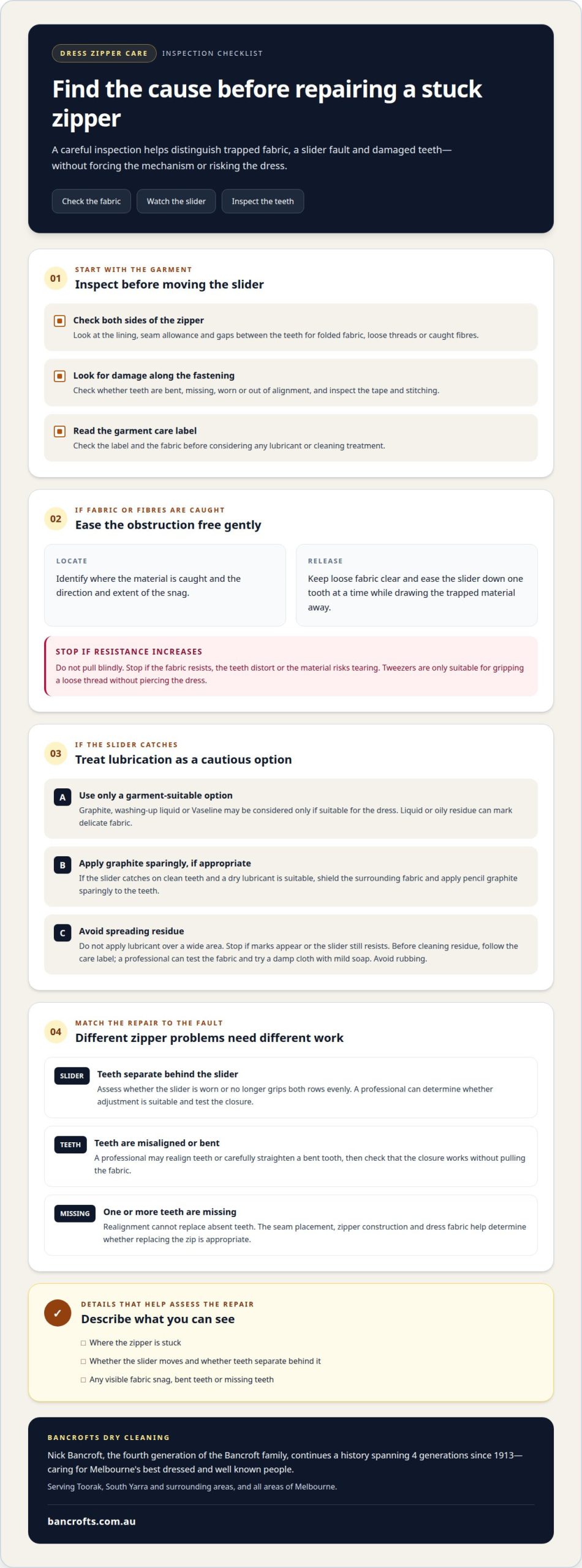
Inspect both sides of the zipper, including the lining, seam allowance and gaps between the teeth. Look for folded fabric, loose threads or fibres caught around the slider. Identify the snag’s direction and extent before handling it: pulling blindly can tear delicate fabric or bend teeth.
-
Gently Freeing the Caught Material
Hold the garment steady and keep loose fabric clear of the slider’s path. Ease the slider down one tooth at a time while gently drawing the trapped material away, opposite the direction of closure. Use tweezers only if they can grip a loose thread without piercing the dress. Stop if the fabric resists or the teeth distort.
Professional options for handling missing zipper teeth
Missing teeth can make a zipper unreliable. How to fix a stuck zipper on a dress depends on the damage and the zipper’s construction.
-
Assessing Missing Zipper Teeth
Check where the slider stops, then inspect the tape, stitching and remaining teeth for wear or distortion. A gap in the fastening path can prevent the zipper from closing. Assess whether the zip can be repaired without compromising the dress fabric.
-
Assessing a Slider That Won’t Close the Teeth
Check whether the slider leaves teeth separated behind it. Distinguish missing teeth from misalignment or a worn slider, as each requires different work. When considering how to fix a stuck zipper on a dress with missing teeth, assess whether realignment can restore closure. It cannot replace absent teeth. Seam placement and fabric also help determine whether replacing the zip is appropriate.
How does a professional fix a zipper slider that moves but won’t close the teeth?
- When assessing how to fix a stuck zipper on a dress, first watch the slider move. Check whether the teeth separate behind it, sit out of alignment, or look bent or worn. This helps distinguish a slider fault from damage to the fastening itself.
- Next, check for trapped material or resistance before adjusting the mechanism. Gently wiggling the puller may release an obstruction, but stop if fabric catches or the teeth begin to distort.
- If the slider no longer grips both rows evenly, a professional assesses whether it can be adjusted. The plates may be pinched gradually with pliers, followed by a careful closure test.
- Fixing a stuck zipper on a dress may involve realigning teeth or replacing damaged components. A professional can remove the top stops and slider, realign the teeth, and refit them. A bent tooth may be carefully straightened with slim needle-nose pliers.
Alterations
An alterations assessment can distinguish a slider fault from damage to the zip tape, stitching or surrounding fabric. The professional considers how the zip sits in the seam, whether the lining moves freely, and whether the repair can preserve the dress’s shape. Missing teeth or a distorted track may need a different repair from a loose slider.
Where repair is appropriate, alterations and repairs can restore function while respecting the garment’s construction. The professional tests the closure, checking that the teeth meet evenly without pulling the fabric. This care is especially relevant to evening and bridal dresses, where seams and proportions shape the design. Nick Bancroft, the fourth generation of the Bancroft family, continues its history spanning 4 generations since 1913, caring for Melbourne’s best dressed and well known people in Toorak, South Yarra and surrounding areas, and all areas of Melbourne.
Complimentary pick-up and delivery service
For a dress requiring professional care, complimentary pick-up and delivery can make arranging garment care more convenient. The service connects Melbourne customers with dry cleaning and specialist care without requiring them to carry a delicate gown across the city. A dress’s beads, lace, fine seams or structured lining can be vulnerable during handling, so thoughtful transport supports its care journey.
For bridal garments, this convenience can sit alongside Wedding Gown Cleaning & Restoration; evening dresses may also need specialist cleaning. The service is suitable for all areas of Melbourne, including Toorak, South Yarra and surrounding areas. Bancrofts’ heritage spans 4 generations since 1913, with Nick Bancroft, the fourth generation of the Bancroft family, caring for Melbourne’s best dressed and well known people. Pick-up and delivery offers a considered way to manage garment care around a busy schedule.
GreenEarth Dry Cleaning
GreenEarth dry cleaning uses GreenEarth solvent, a gentler dry-cleaning solvent for delicate fabrics that does not damage beadwork, sequins, lace or embroidery. This matters after repairs, when cleaning must suit the garment. The professional considers the care label, textile, trims and cleaning needs before treatment. The GreenEarth® Cleaning process is an eco-friendly dry cleaning method that uses no hazardous chemicals and is non-toxic to the environment. It offers an alternative for caring for high-fashion, bridal and evening garments while attending to delicate finishes. Cleaning does not correct missing zipper teeth or a faulty slider; those need alterations and repairs. Treating cleaning and zip repair as distinct needs helps preserve both appearance and function.
GreenEarth dry cleaning solution
The GreenEarth dry cleaning solution pairs garment care with an environmental focus. The GreenEarth® Cleaning process uses no hazardous chemicals and is non-toxic to the environment. Its relevance to a dress depends on the care label, fabric and finish, which guide the professional’s treatment. GreenEarth Cleaning has redefined garment care since 1999, offering an approach suited to delicate pieces that need considered handling.
The Optimized GreenEarth Cleaning System uses Sustain detergent, which requires lower dosage levels and is safe enough to avoid hazardous warning symbols. Bancrofts has achieved a saving of at least 50% per load with the GreenEarth Cleaning system. These are distinct benefits: the dosage and process inform environmental considerations, while the saving describes system performance. Cleaning supports fabric care, but a faulty zip still needs repair.
Cleaning Household Items
Household textiles need care suited to their fibres, construction and finish. A lined curtain, decorative pillow cover and lightweight tablecloth can respond differently to cleaning, so check the care label and trims. A professional assessment considers colour, embellishment, lining and stains before choosing a method. For a household item with a zip, cleaning and fastening repair are separate tasks: cleaning cannot replace missing teeth or fix a faulty slider.
This measured approach helps protect textiles that hold a home’s character, from heirloom linen to carefully made soft furnishings. Nick Bancroft, the fourth generation of the Bancroft family, carries a history spanning 4 generations since 1913, caring for Melbourne’s best dressed and well known people. The service reaches Toorak, South Yarra and surrounding areas, as well as all areas of Melbourne.
Household Cleaning
Household cleaning extends fabric care beyond the wardrobe. Household textiles can differ in fibre, construction and finish, so their care needs are assessed with attention to the item and its condition. Bed linen and table linen are also available for laundry and pressing, helping these frequently used pieces retain a neat, considered appearance. Cleaning and pressing address textile care, not zipper repair; a damaged fastening needs a separate alterations assessment.
Nick Bancroft, the fourth generation of the Bancroft family, continues a history spanning 4 generations since 1913, caring for Melbourne’s best dressed and well known people. Household cleaning is suitable for Toorak, South Yarra and surrounding areas, as well as all areas of Melbourne. This offers a considered way to care for household textiles alongside the garments that hold their own place in a home’s story.
Bancrofts Dry Cleaning
If a dress zip remains stuck or its slider will not close, Bancrofts Dry Cleaning in South Yarra can assess the problem. A professional can distinguish slider, tooth and fabric faults to determine suitable care for a delicate or high-value garment. Dry Cleaning and Wedding Gown Cleaning & Restoration provide careful attention to a garment’s fabric, finish and construction.
Nick Bancroft, the fourth generation of the Bancroft family, carries forward a history spanning 4 generations since 1913, caring for Melbourne’s best dressed and well known people. Based in South Yarra, the service is suitable for Toorak, South Yarra and surrounding areas, as well as all areas of Melbourne. Contact Bancrofts Dry Cleaning to discuss your dress.
Frequently Asked Questions
What does a professional check when a zipper is stuck on a dress?
A professional checks both zipper tapes and seam attachment to locate whether the fault sits in the slider track or garment construction. The inspection also considers the zip’s top and bottom stops, nearby lining and care label, since these details shape a safe repair. At Bancrofts Dry Cleaning, Nick Bancroft, the fourth generation of the Bancroft family, continues its history spanning 4 generations since 1913, caring for Melbourne’s best dressed and well known people.
Which household lubricants might a professional consider for a dress zipper?
For a dry, localised catch, pencil graphite may help; a tiny amount of washing-up liquid may be an option if the fabric can be cleaned afterwards. Vaseline is another possibility for a small obstruction, but its oily residue needs careful handling. Do not apply washing-up liquid or Vaseline to a dress without professional guidance and fabric testing, as residue may stain or damage delicate fabric. Choose based on the dress fibre, finish and nearby trims. Applying any option broadly can spread residue beyond the teeth.
How does a professional free fabric caught in a dress zipper without damaging it?
To release a snag, first identify which side of the slider holds the fabric, then create slack instead of pulling the garment tight. If fine lining is folded into the track, easing the slider towards the snag can expose the trapped edge. Tweezers may lift loose fibres, but keep pointed tips clear of the weave and stitching.
How can a professional tell if a stuck dress zipper needs replacing?
Consider replacing the zip if teeth are missing along the closure, the tape is damaged, or the slider repeatedly separates the rows after alignment. A local fault with intact tape may be repairable; a gap in the working track can prevent reliable fastening. The dress’s seam construction, lining and fabric condition also help determine whether replacement can be fitted without compromising the garment.
What should a professional avoid when unsticking a zipper on delicate or formalwear?
Don’t force the slider, squeeze it aggressively with pliers, or apply oily lubricant without considering the dress fabric and finish. These actions can bend teeth, catch delicate cloth or leave residue. Avoid cutting a snagged thread or probing beadwork with sharp tools. For formalwear in Toorak, South Yarra and greater Melbourne, careful handling helps preserve embellishment and seam integrity.
