

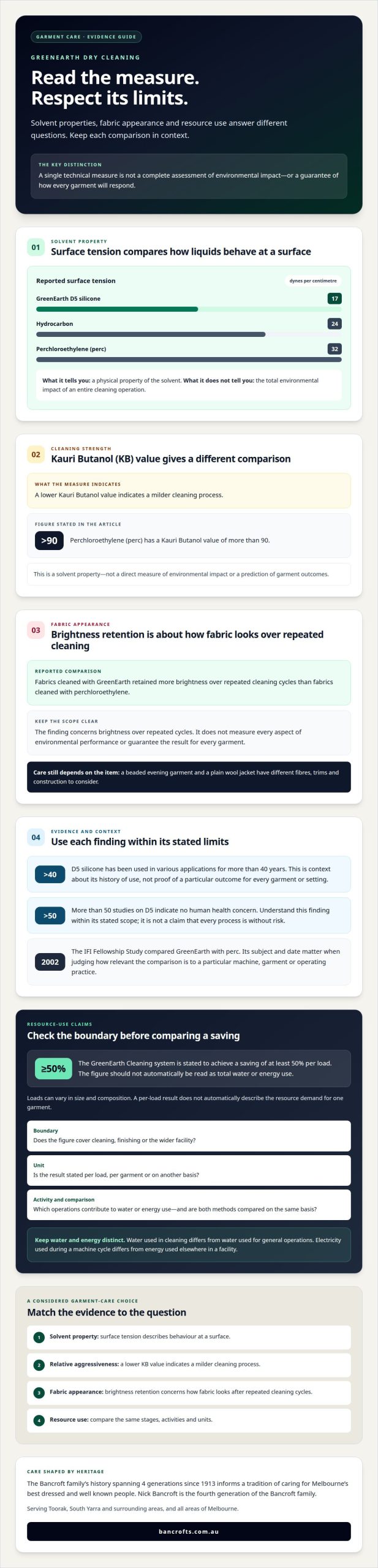
What if garment care could use a gentler cleaning solvent while reducing resource use? GreenEarth dry cleaning in Melbourne uses a silicone-based solvent rather than water as the cleaning medium, and the GreenEarth Cleaning system achieves a saving of at least 50% per load. Understanding what that means for water and energy use helps you make a more informed choice for treasured garments.
Choosing a cleaning method means considering more than the finish. The process matters for both fabric care and environmental impact. This article explains GreenEarth dry cleaning in Melbourne, how to interpret resource-use claims, and why careful handling matters for delicate and valuable textiles.
That commitment to preservation reflects the Bancroft family’s history spanning 4 generations since 1913. Nick Bancroft, the fourth generation of the Bancroft family, continues a tradition of caring for Melbourne’s best dressed and well known people, with service for Toorak, South Yarra and surrounding areas, as well as all areas of Melbourne.
Key Takeaways
- Understand how a silicone-based cleaning solvent treats garments without using water as the cleaning medium.
- Interpret the GreenEarth system’s stated saving of at least 50% per load in context, rather than assuming it represents total water or energy use.
- Learn which parts of a cleaning cycle influence resource consumption and why the garment’s fabric and care needs matter.
- Explore how the Bancroft family’s four generations since 1913 inform garment preservation for Toorak, South Yarra, surrounding areas and all areas of Melbourne.
Environmental impact of the cleaning process
GreenEarth’s D5 silicone has a surface tension of 17 dynes per centimetre. That measurement describes how the liquid behaves at a surface, not the environmental performance of an entire cleaning operation. It helps explain a physical property of the solvent, but cannot by itself establish a process’s total impacts. Understanding the distinction keeps comparisons precise and avoids treating one technical measure as a complete environmental assessment.
For context, perc has a surface tension of 32 dynes per centimetre, while hydrocarbon measures 24 dynes per centimetre. These figures allow comparison between solvent properties. They don’t describe every element of a dry-cleaning cycle, nor do they determine how a specific garment will respond. A technical comparison is most useful when its scope remains clear.
Cleaning-solvent strength is described using the Kauri Butanol (KB) value. A lower value indicates a milder cleaning process, while perc has a Kauri-butanol value of more than 90. This measure can provide context when comparing cleaning solvents. It should be read as a property of the solvent, rather than a direct measure of environmental impact or garment outcomes.
Garment appearance is another point of comparison. Fabrics cleaned with GreenEarth retained more brightness over repeated cleaning cycles than fabrics cleaned with perchloroethylene. For a vintage jacket or a frequently worn formal garment, colour retention can help it stay in your wardrobe longer. This finding concerns brightness over repeated cycles; it does not measure every aspect of environmental performance.
D5 silicone has been used in various applications for more than 40 years. That history provides context for the solvent’s established use, rather than proof of a particular outcome for every garment or cleaning setting. More than 50 studies on D5 indicate no human health concern. The finding should be understood within that stated scope, not as a claim that every process is without risk.
The IFI Fellowship Study comparing GreenEarth with perc was conducted in 2002. Its comparison adds context to discussion of these cleaning approaches. A study’s date and subject matter are important when interpreting its relevance. The 2002 comparison concerns GreenEarth and perc; it should not be treated as a universal measurement of every machine, garment or operating practice.
For eco-conscious readers, the practical lesson is to distinguish between types of evidence. Surface tension describes a solvent property, the Kauri Butanol value addresses relative aggressiveness, and brightness retention concerns a fabric’s appearance after repeated cleaning. Each measure answers a different question, so none alone gives a complete account of environmental impact.
Garment care also means choosing treatment suited to the item. A beaded evening garment needs attention to its embellishments and construction; a plain wool jacket has different considerations. GreenEarth is described as gentler on delicate fabrics and as not damaging beadwork, sequins, lace or embroidery. Careful assessment connects the cleaning process with the textile being treated.
These distinctions make environmental claims easier to interpret without losing sight of garment preservation. D5’s measured properties, the study comparison and reported brightness retention each contribute a different piece of context. For a treasured garment, consider those details alongside its fibres, trims and care requirements. A well-framed comparison recognises both the limits of individual measures and the value of preserving clothing through attentive care.
Water and energy conservation
Water and energy are separate resource measures, and each needs a clearly defined boundary. In garment cleaning, the cleaning cycle is only one part of the picture. A useful assessment distinguishes resources used during treatment from those used for finishing and general facility operations. Without that distinction, a claim about one stage can be mistaken for a description of the entire service.
Water accounting can distinguish direct use in cleaning from other uses at a site. Water may also support general operations, so these categories should not be combined without explanation. The same applies to energy: electricity used during a machine cycle differs from energy used elsewhere in a facility.
A per-load result also needs context. Loads can vary in size and composition, so a figure per load does not automatically describe the resource demand for one garment. Comparisons are more meaningful when they use a consistent basis, such as the same load type and stages of work. The scope matters as much as the result.
Operational records can make resource use easier to understand. At Bancrofts Dry Cleaning, a facility can track water and electricity against the work completed, then review those measures over time. Separating cleaning, finishing and general operations helps show where demand occurs. This accounting does not assume that every garment or cycle has identical requirements.
Energy conservation also depends on equipment management. An operational review can consider whether machines are used for suitable work, whether settings match the task, and whether equipment is left running unnecessarily. These are general efficiency principles, not claims about the performance of a particular machine or site.
Resource comparisons should therefore identify:
- The boundary: Whether the figure covers the cleaning cycle, finishing, or the wider facility.
- The unit: Whether results are stated per load, garment, or another basis.
- The activity: Which operations contribute to the reported water or energy use.
- The comparison: Whether the same scope and basis apply to each method being compared.
For readers in South Yarra and across Melbourne exploring GreenEarth dry cleaning Melbourne options, this framework helps put environmental claims in context. A solvent comparison alone cannot establish water or energy consumption. Those outcomes depend on the process boundary measured, the equipment involved and the activities included in the accounting.
There is also a difference between reducing resources during garment care and reducing the need for repeated care. Follow the care label and consider the garment’s actual condition to avoid unnecessary cleaning. A lightly worn item may not need the same treatment as clothing with visible soiling. The appropriate approach depends on the textile and how it is used.
When reading a conservation claim, look for a clear explanation of what is measured and which operations are included. A result tied to a defined stage is more informative than a broad statement without a stated boundary. This helps eco-conscious consumers weigh resource information alongside fabric needs, without assuming one figure represents every part of garment care.
The equipment and operating conditions considered in the assessment also shape the final outcome. A property of water should not be mistaken for a record of water demand: Water has a surface tension of 72 dynes per centimetre. That value describes a characteristic of water, but it does not state how much water a cleaning service uses, where it is used, or what share belongs to a particular operation. Those questions require an account of actual use with a stated boundary. Keeping material properties distinct from consumption measures prevents unlike information from being presented as if it were interchangeable.
Clear reporting also explains how resource records relate to conservation decisions. A change in a recorded total is meaningful only if the scope and basis of measurement remain clear; otherwise, it is hard to tell whether the work or the accounting changed. For water and energy alike, records should identify the activities covered and avoid implying that a measure from one part of a service represents every part. This lets readers consider reported demand on its own terms, without treating a general property, an isolated process measure or a broad operational claim as a complete account. Careful descriptions can support grounded discussion of where conservation may be appropriate, while leaving results to be established through measurements for the relevant service and facility.
Bancrofts Dry Cleaning
Bancrofts Dry Cleaning in South Yarra matches garment care to the item’s fabric, construction and care label. Its Dry Cleaning service is suited to garments requiring professional cleaning, while Shirt Laundry addresses the distinct needs of work and formal shirts. For a wedding gown with sentimental value, Wedding Gown Cleaning & Restoration provides dedicated care.
When choosing GreenEarth cleaning, share details about the garment’s embellishments, lining and overall condition. These details help guide an approach suited to a treasured piece, rather than treating every textile alike.
For considered care of a garment you value, contact Bancrofts Dry Cleaning in South Yarra.
Choose care that honours each garment
Start by considering the needs of the garment itself: its fabric, construction, finish and personal significance. GreenEarth dry cleaning in Melbourne is one part of the decision, alongside careful assessment and appropriate handling. A cherished suit, everyday shirt and heirloom wedding gown each deserve care suited to their role in your wardrobe.
Bancrofts Dry Cleaning offers dry cleaning, shirt laundry, and wedding gown cleaning and restoration. The Bancroft family’s history spans 4 generations since 1913, with Nick Bancroft as the fourth generation of the Bancroft family, caring for Melbourne’s best dressed and well known people. Service is suited to Toorak, South Yarra and surrounding areas, as well as all areas of Melbourne.
For considered care of garments you value, contact Bancrofts Dry Cleaning. Give your treasured pieces the attention they deserve.
Frequently Asked Questions
How do I find a GreenEarth dry cleaner near me in Melbourne?
For GreenEarth dry cleaning in Melbourne, Bancrofts Dry Cleaning in South Yarra serves Toorak, South Yarra and surrounding areas, as well as all areas of Melbourne. Nick Bancroft, the fourth generation of the Bancroft family, continues its history spanning 4 generations since 1913, caring for Melbourne’s best dressed and well known people. For a designer jacket, bridal gown or everyday garment, contact Bancrofts to discuss appropriate care.
